Is Insurance Coverage for Men’s Health Treatment Worth It in Indiana?

Yes, insurance coverage for men’s health treatment in Indiana is worth it if you have a diagnosed medical condition, use in-network providers, and meet the medical necessity criteria set by your plan. Coverage for testosterone replacement therapy (TRT), erectile dysfunction (ED) treatment, and prostate cancer screening varies by insurer, plan tier, and whether care is deemed medically necessary or elective. This guide breaks down what Indiana residents can expect to pay, what’s covered, and whether insurance-backed treatment makes financial sense in 2026.
What You Get: Coverage Inclusions vs. Out-of-Pocket Extras
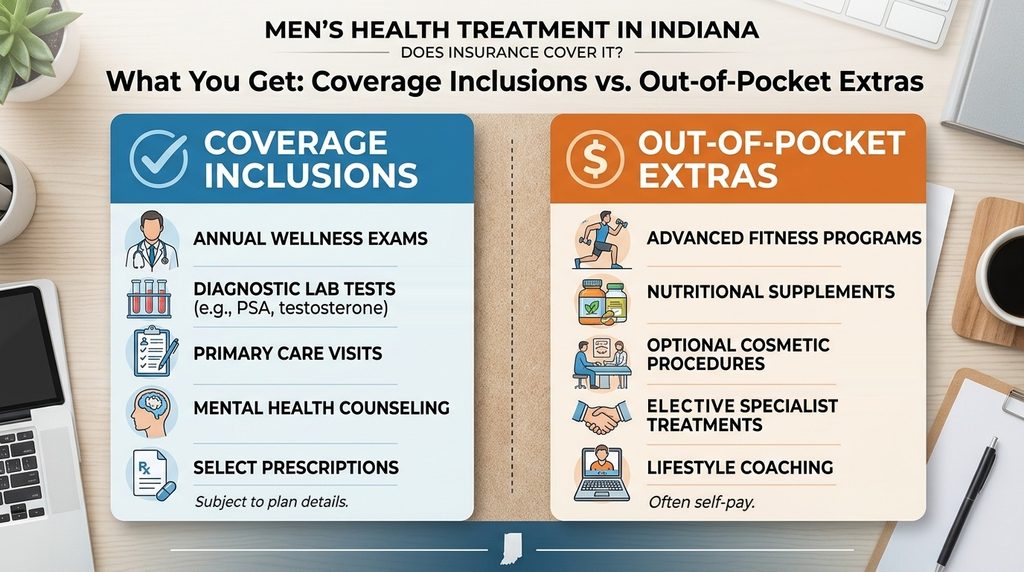
Indiana health insurance plans, whether purchased through the ACA Marketplace, provided by an employer, or administered through Medicaid Indiana or Medicare, differ widely in what they classify as essential versus elective men’s health treatment options. The distinction usually comes down to a diagnosis code (ICD-10) tied to a documented medical condition rather than a general wellness goal.
Typically Covered Under Most Indiana Health Insurance Plans
- Men’s wellness exams coverage: Annual physicals and preventive care men’s health screenings are covered at 100% with no copay under ACA-compliant plans, as required by the ACA’s preventive services provision.
- Prostate cancer screening: PSA tests are commonly covered for men aged 55–69, and sometimes earlier for men with a family history, in line with United States Preventive Services Task Force (USPSTF) guidelines.
- Diagnostic testosterone therapy insurance: Lab work confirming low testosterone (below 300 ng/dL on two separate morning tests) is typically covered when ordered by a primary care physician or urologist.
- Specialist referral insurance coverage: Referrals to urology services within insurance networks are generally included, though some HMO plans require prior authorization before the first visit.
- Diabetes and cardiovascular screening: Because low testosterone and ED often occur alongside metabolic conditions, many plans cover A1C and lipid panels as part of a men’s health workup.
Often Requires Extra Out-of-Pocket Costs
- Erectile dysfunction insurance coverage: Oral medications (sildenafil, tadalafil) are frequently excluded or placed on high formulary tiers. Brand-name Viagra and Cialis are almost never covered, while generic sildenafil may be partially covered under some Gold-tier plans.
- TRT maintenance: Ongoing injections, gels, or pellets may require insurance prior authorization for men’s health treatment, with documentation proving hypogonadism, renewed annually or semi-annually.
- Out-of-network low testosterone clinic visits: You may pay the full out-of-pocket cost for men’s health treatment without insurance in Indiana if you use a non-contracted provider, even if your plan covers the service category.
- Elective procedures: Certain ED devices, penile implants without a qualifying diagnosis, and wellness-only hormone panels are rarely covered.
- Compounded testosterone: Compounded formulations, as opposed to FDA-approved brands, are almost universally excluded from standard formularies.
Cost Breakdown: Premiums, Copays, and Deductibles in 2026

Indiana Marketplace premiums rose sharply for 2026 after enhanced federal premium tax credits expired. The average Indiana Marketplace premium is about $623 per month before subsidies and about $222 per month after premium tax credits. Bronze plans carry the lowest premiums but the highest deductibles, which makes routine men’s health services more expensive until the deductible is met.
| Service | With Insurance (In-Network) | Without Insurance |
|---|---|---|
| Men’s wellness visit | $0–$25 copay | $150–$300 |
| Testosterone lab panel | $20–$50 copay | $80–$200 |
| TRT monthly injections | $15–$75/month | $100–$300/month |
| ED medication (30-day supply) | $10–$60 copay | $300–$600 |
| Prostate cancer screening (PSA) | $0 under most plans (preventive) | $75–$150 |
| Urologist specialist visit | $40–$75 copay | $200–$400 |
| TRT pellet insertion (quarterly) | $50–$150 copay | $400–$700 |
| Semen analysis/fertility workup | $30–$80 copay | $150–$350 |
Costs shown are typical estimates. Actual prices vary by provider, plan, and location, so confirm costs with your insurer and clinic before treatment.
Deductibles also matter. In 2026, HealthCare.gov Bronze plans average about $7,500 in deductibles and Silver plans (without cost-sharing reductions) about $5,300, and no ACA plan can have an out-of-pocket maximum above $10,600 for an individual. Deductibles and out-of-pocket totals reset each plan year, so timing non-urgent care, such as a January versus December urologist visit, affects your costs.
Carrier-Specific Coverage Differences
- Anthem Blue Cross Blue Shield: Does Anthem cover low testosterone treatment in Indiana? Yes, when supported by two separate morning blood draws confirming deficiency, plus documented symptoms such as fatigue or reduced libido.
- UnitedHealthcare: Does UnitedHealthcare cover prostate screening in Indiana? Yes, PSA testing is covered as preventive care for eligible age groups, and digital rectal exams may be included during annual wellness visits. Note that UnitedHealthcare’s 2026 Indiana Marketplace plans are offered in only five counties.
- Cigna and Aetna: Both may require prior authorization for ongoing TRT, and some employer-sponsored plans use step therapy for ED medications, meaning generics must be tried before brand-name drugs are approved. Requirements vary by plan, so check your plan’s formulary. Aetna no longer sells individual Marketplace plans in Indiana as of 2026, so its coverage applies mainly to employer plans.
- Indiana Health Coverage Programs (IHCP): IHCP, which administers Medicaid Indiana, covers medically necessary urology services but excludes most ED medications and limits TRT coverage to confirmed hypogonadism cases with endocrinologist sign-off.
- Medicare Parts B and D: Part B covers an annual PSA screening for men 50 and older at no cost, and Part D covers medically necessary TRT prescribed for diagnosed hypogonadism, though formulary tiers vary by plan.
Expected Benefits & ROI Analysis
Early detection drives the strongest return on investment. According to the American Cancer Society, the five-year relative survival rate for localized prostate cancer exceeds 99%, versus about 37% for distant-stage diagnosis. A $0 PSA test can help catch cancer early, when treatment is typically far less extensive and costly than care for advanced disease.
For patients with confirmed hypogonadism, covered TRT often improves energy, libido, muscle mass, and mood within 3–6 months, per Endocrine Society clinical guidelines. The indirect costs of untreated low-T symptoms, such as lost productivity, metabolic syndrome, and reduced bone density, can reach $600–$3,600 annually. That often exceeds the cost of insured treatment, which can run as low as $180–$900 per year with copays.
ED treatment insurance ROI is less clear-cut. Because many plans exclude ED medications, patients often pay cash regardless of coverage. Many Indiana men find that a $99/month telehealth subscription for generic sildenafil is faster and comparable in cost once step therapy and prior authorization hurdles are factored in.
Who Should—and Shouldn’t—Rely on Insurance for Men’s Health Treatment
Insurance Coverage Makes Sense If You:
- Have employer-sponsored insurance with a documented men’s health benefit tier and a Health Reimbursement Arrangement (HRA) to offset copays
- Qualify for Medicaid Indiana or Medicare coverage for men’s health services, particularly for preventive screenings
- Have lab-confirmed low testosterone or a diagnosed urologic condition, such as benign prostatic hyperplasia (BPH) or chronic hypogonadism
- Use a Health Savings Account (HSA) to cover deductible costs with pre-tax dollars, reducing treatment costs by 20–30% depending on your tax bracket
- Have a family history of prostate cancer and need more frequent screening than standard guidelines recommend
Insurance May Not Be Worth Pursuing If You:
- Need only ED medication without an underlying diagnosed condition, since cash-pay telehealth may be cheaper and faster
- Are uninsured and your subsidized Marketplace premium exceeds the cost of occasional cash-pay visits (a healthy man visiting a clinic twice a year may spend less than $600 annually)
- Primarily want elective wellness optimization rather than medically necessary treatment
- Live in an area with limited in-network urology providers, where travel costs offset copay savings
Alternatives to Consider
- Telehealth services: Many virtual men’s health clinics offer flat-rate TRT and ED consultations starting at $99/month, often including medication shipping.
- Men’s health clinic Indianapolis locations: Specialized clinics offer bundled cash-pay packages for diagnostics and treatment, typically $150 to $500 per month.
- HSA/FSA funding: Pre-tax HSA dollars can offset 20–30% of treatment costs, and unused HSA funds roll over year to year, unlike FSA accounts, which often have a use-it-or-lose-it deadline. Starting in 2026, all Bronze Marketplace plans are HSA-eligible.
- Direct primary care (DPC) memberships: Some Indiana practices charge flat monthly fees ($50–$100) for unlimited visits, which can include basic men’s health screening.
For plan-by-plan comparisons, resources explaining men’s health insurance coverage Indiana can help you cross-reference carrier policies before enrolling or switching plans.
How to Check Insurance Coverage for Men’s Health Treatment in Indiana
- Call the member services number on your insurance card and ask about testosterone therapy and ED treatment coverage, using the CPT and ICD-10 codes relevant to your condition.
- Request a list of in-network men’s health providers, including urologists and low testosterone clinics, and confirm they are accepting new patients.
- Ask your primary care physician to document medical necessity, including symptom history and prior lab results, before requesting specialist referral coverage.
- Request a written pre-authorization determination before starting treatment.
- If your claim is denied, file an internal appeal within 180 days, per Indiana Department of Insurance guidelines, and request an external review if the appeal is also denied.
Frequently Asked Questions
Does Anthem cover testosterone therapy in Indiana?
Yes. Anthem covers TRT in Indiana when two separate morning blood tests confirm low testosterone and your provider documents symptoms such as fatigue or reduced libido. Ongoing treatment usually requires prior authorization.
Does Indiana Medicaid cover ED medication?
Generally, no. Indiana Health Coverage Programs (IHCP) excludes most ED medications but covers medically necessary urology services and TRT for confirmed hypogonadism with endocrinologist sign-off.
How much does TRT cost without insurance in Indiana?
TRT injections typically cost $100–$300 per month without insurance, and pellet insertions run $400–$700 per quarter. With in-network insurance, injections often cost $15–$75 per month.
Is a PSA test free under insurance in Indiana?
Under most plans, yes. Many plans cover PSA screening as preventive care, and Medicare Part B covers one PSA test per year at no cost for men 50 and older.
Can I use my HSA for TRT or ED treatment?
Yes. Prescribed TRT and ED treatment are generally HSA-eligible medical expenses, and paying with pre-tax HSA dollars can lower your effective cost by roughly 20–30%.
Is telehealth TRT or ED treatment cheaper than using insurance?
It can be, especially for ED. Telehealth plans start around $99 per month and skip prior authorization. For diagnosed hypogonadism, in-network insurance is usually cheaper long term.
How do I appeal a denied men’s health insurance claim in Indiana?
File an internal appeal with your insurer within 180 days of the denial. If that appeal is denied, request an external review through the Indiana Department of Insurance.
Final Verdict: Is It Worth It?
Insurance coverage for men’s health treatment in Indiana is worth pursuing when you have a documented diagnosis and access to in-network urology or primary care providers. The ROI is strongest for prostate cancer screening and diagnosed TRT, where covered costs can run 60–80% lower than out-of-pocket low testosterone clinic rates. It’s less valuable for elective ED medication, where cash-pay telehealth often matches insurance copays once prior authorization delays are factored in. Before enrolling, verify coverage terms with your carrier, such as Anthem, UnitedHealthcare, Cigna, or Aetna, and confirm Medicaid Indiana or Medicare eligibility if applicable. For most Indiana men in 2026, the best value comes from using insurance for diagnostic and preventive services and cash-pay or telehealth for elective treatment.