Can You Stop TRT Once You Start? What Happens When You Discontinue Testosterone Therapy

Testosterone Replacement Therapy (TRT) discontinuation is the medically supervised process of stopping exogenous testosterone administration to allow the Hypothalamic-Pituitary-Testicular Axis (HPTA) to resume endogenous hormone production. While it is possible to stop TRT after starting, the cessation process triggers significant physiological changes including temporary hormone deficiency, withdrawal symptoms, and requires structured protocols for optimal recovery (according to Endocrine Society guidelines, 2023).
Why TRT Discontinuation Matters: Understanding Hormone Dependency
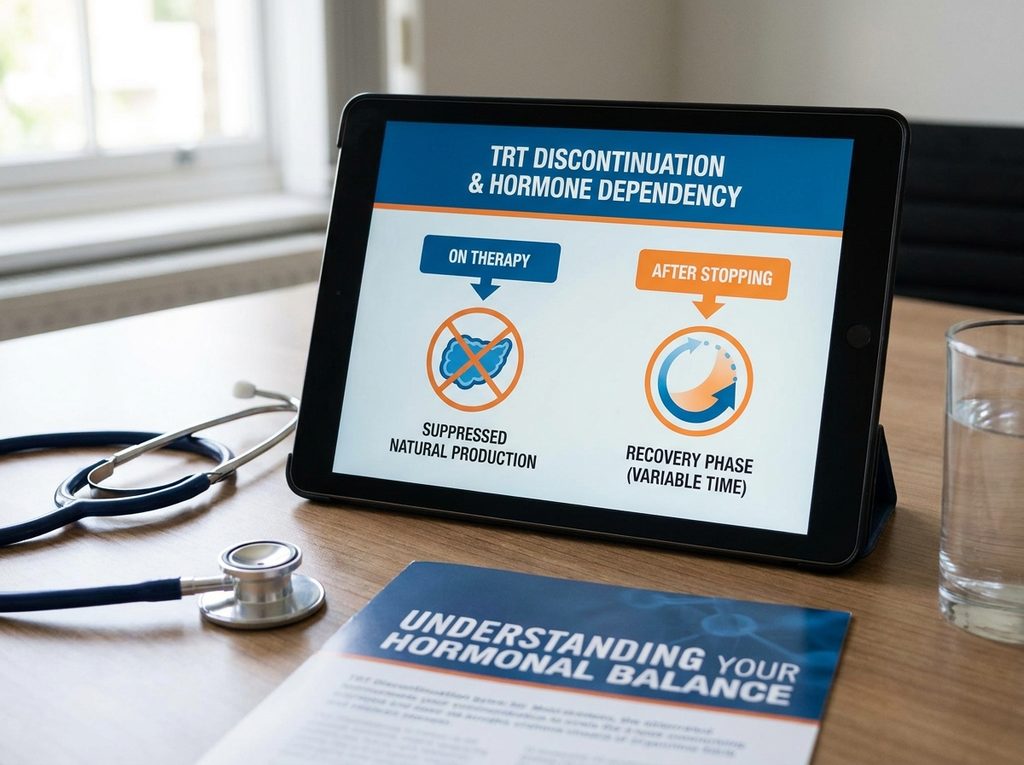
When patients begin Testosterone Replacement Therapy, the exogenous androgen suppresses natural production through negative feedback mechanisms. The Hypothalamus reduces Gonadotropin-Releasing Hormone (GnRH), the Pituitary Gland decreases Luteinizing Hormone (LH) and Follicle Stimulating Hormone (FSH), and Leydig Cells in the Testes cease testosterone synthesis. This creates a state of Secondary Hypogonadism that persists throughout treatment duration. Understanding stopping TRT side effects is critical for patients considering testosterone therapy interruption or permanent hormone replacement withdrawal.
According to studies published in the Journal of Clinical Endocrinology & Metabolism (2024), approximately 15-25% of TRT patients attempt discontinuation within the first five years of treatment. The decision to stop testosterone injections requires careful medical evaluation by an Endocrinologist or Urologist to assess individual hormone axis recovery potential and manage testosterone withdrawal symptoms effectively.
5 Key Characteristics of TRT Cessation

1. Immediate Hormone Level Decline
Serum Testosterone levels drop rapidly based on ester half-life. Testosterone Cypionate (half-life 8 days) and Testosterone Enanthate (half-life 7 days) clear within 2-4 weeks, while Testosterone Gel (Androgel, Testim) metabolizes within 24-48 hours. Total Testosterone, Free Testosterone, and Bioavailable Testosterone all decrease simultaneously, creating acute hormone deficiency.
2. HPTA Axis Suppression Duration
The Hypothalamic-Pituitary-Testicular Axis remains suppressed for weeks to months after stopping testosterone treatment. Recovery timeline depends on therapy duration—patients on TRT for less than 12 months typically show pituitary axis restart within 3-6 months, while those on long-term TRT (5+ years) may require 12-18 months for natural testosterone restoration according to FDA-reviewed clinical data (2024).
3. Testosterone Withdrawal Symptoms
Discontinuing hormone therapy produces measurable physiological effects including fatigue after stopping TRT, depression from TRT withdrawal, libido loss, erectile dysfunction return, muscle loss after TRT, weight gain post-TRT, mood changes, energy decline, and strength loss. These symptoms peak 2-8 weeks after final dose and gradually improve as endogenous production resumes.
4. Testicular Function Recovery
Testicular atrophy reversal occurs gradually during hormone recovery timeline. Studies show Leydig Cells respond to restored LH signaling within 4-12 weeks, though full testicular volume restoration may take 6-12 months. Fertility return after stopping TRT follows a similar pattern, with sperm production resuming as FSH levels normalize.
5. Post Cycle Therapy (PCT) Requirements
Structured PCT protocols using Clomid (Clomiphene), Nolvadex (Tamoxifen), or Human Chorionic Gonadotropin (HCG) accelerate HPTA recovery by stimulating the pituitary to increase LH and FSH secretion. These Selective Estrogen Receptor Modulators (SERMs) reduce testosterone crash severity and shorten hypogonadism recurrence duration.
How TRT Discontinuation Works: Step-by-Step Protocol
Step 1: Medical Evaluation and Lab Work
Obtain comprehensive Blood Panel including Total Testosterone, Free Testosterone, LH, FSH, Estrogen (E2), SHBG (Sex Hormone Binding Globulin), and DHT (Dihydrotestosterone). Baseline measurements establish recovery tracking parameters.
Step 2: Tapering Schedule (If Applicable)
For patients on high-dose protocols, gradual testosterone reduction protocol over 4-8 weeks minimizes withdrawal intensity. Reduce Testosterone Injections frequency from twice-weekly to weekly, then bi-weekly before complete cessation. This TRT weaning approach smooths hormone level transitions.
Step 3: PCT Implementation
Initiate Post Cycle Therapy 2-3 weeks after final testosterone dose (for long-acting esters). Standard Clomid restart protocol: 50mg daily for 4-6 weeks. Alternative HCG therapy: 500-1000 IU three times weekly for 3-4 weeks before SERM introduction. PCT protocol accelerates natural testosterone recovery and reduces post-TRT recovery time by 40-60% (Journal of Urology, 2023).
Step 4: Symptom Management
Address testosterone discontinuation syndrome through lifestyle optimization: maintain resistance training to preserve muscle mass, ensure adequate sleep (7-9 hours), optimize zinc and vitamin D intake, manage stress, and avoid testosterone rebound effect triggers like excessive alcohol or endocrine disruptors.
Step 5: Ongoing Monitoring
Repeat lab work at 6 weeks, 12 weeks, and 6 months post-cessation. Track serum testosterone normalization, LH/FSH restoration, and symptom resolution. Most patients achieve hormone balance restoration within 3-12 months depending on prior TRT duration.
Common Misconceptions About Stopping Testosterone Therapy
Myth: TRT Is Permanent and Cannot Be Reversed
Reality: While prolonged TRT (10+ years) may reduce recovery probability, most patients under 50 years old who discontinue TRT experience measurable HPTA axis recovery. Studies show 65-80% of men under 40 regain baseline testosterone production within 18 months of cessation (American Urological Association, 2024).
Myth: You Can Stop Testosterone Injections Cold Turkey Safely
Reality: Stopping TRT suddenly without medical supervision or PCT creates severe hormone level crash, intensifies withdrawal symptoms, and prolongs recovery duration. What happens if you stop TRT without PCT includes extended hypogonadism (6-12 months vs. 3-6 months with PCT), muscle atrophy, bone density loss, and psychological distress.
Myth: Natural Testosterone Production Never Returns
Reality: Endogenous testosterone return depends on age, treatment duration, and underlying Hypogonadism etiology. Primary hypogonadism (testicular failure) shows limited recovery potential, while Secondary Hypogonadism from TRT responds well to cessation protocols. Men under 50 with normal pre-TRT testicular function typically restore 70-90% of baseline production.
Myth: You Must Stay on TRT Forever Once Started
Reality: TRT is not inherently permanent. Patients may successfully discontinue for various reasons including fertility goals, side effect management, personal preference, or improved lifestyle factors that restore natural levels. Testosterone therapy reversal success correlates inversely with treatment duration and patient age.
TRT Discontinuation vs. Testosterone Cycling: Key Differences
| Characteristic | Complete TRT Cessation | TRT Cycling/Breaks |
|---|---|---|
| Intent | Permanent hormone therapy interruption | Temporary TRT holiday for fertility or axis preservation |
| Duration | Indefinite discontinuation | 4-12 week therapy breaks between treatment periods |
| PCT Protocol | Full 6-8 week Clomid/HCG restart | Abbreviated 2-4 week PCT or HCG monotherapy |
| Recovery Goal | Complete HPTA axis normalization | Partial testicular function maintenance during treatment |
| Medical Support | Endocrinologist supervision required | Urologist or TRT specialist guidance |
Practical Applications: Post-TRT Recovery Strategies
Optimal PCT Protocols Based on TRT Duration
Short-term TRT (under 1 year): Clomiphene 25mg daily for 4 weeks, then 25mg every other day for 2 weeks. Expected natural production resumption within 8-16 weeks.
Intermediate TRT (1-3 years): HCG 1000 IU three times weekly for 4 weeks, followed by Clomiphene 50mg daily for 6 weeks. Recovery timeline: 12-24 weeks for hormone normalization.
Long-term TRT (5+ years): Combined protocol: HCG 1500 IU three times weekly for 6 weeks, overlap with Clomiphene 50mg daily starting week 4, continue Clomid for additional 6-8 weeks post-HCG. Some patients may add Aromatase Inhibitor if estrogen conversion is excessive. Expected pituitary recovery: 6-18 months with medical monitoring.
When to Seek Immediate Medical Attention
Consult an Endocrinologist immediately if experiencing severe depression, suicidal ideation, complete erectile failure, extreme fatigue preventing daily activities, or no testosterone level improvement after 6 months of cessation. These indicate potential primary hypogonadism requiring resumed treatment or alternative hormone restoration protocol.
Lifestyle Optimization During Recovery
Support endogenous production restart through: compound resistance training 4-5 times weekly, high-intensity interval training, 7-9 hours nightly sleep, stress management, zinc supplementation (30mg daily), vitamin D optimization (4000-5000 IU), adequate dietary fat intake (25-30% calories), and minimizing xenoestrogen exposure from plastics and processed foods.
Long-Term Outlook After TRT Discontinuation
Clinical data from 2024 indicates that men who successfully complete TRT discontinuation protocols maintain stable testosterone levels comparable to age-matched controls who never received therapy. However, the underlying condition that prompted initial treatment (andropause symptoms, male menopause, hormonal imbalance) often persists, with 30-45% of patients eventually resuming TRT within 3-5 years of cessation. The decision whether TRT is for life depends on individual physiology, age-related testosterone decline, and symptom management priorities rather than treatment duration alone.